
Comente, Curta e Compartilhe – Há momentos no calendário que não pedem explicação, pedem recolhimento. A Quinta-Feira de Endoenças é um desses raros instantes em que o tempo parece desacelerar, como se a própria vida nos convidasse a olhar para dentro antes de seguir adiante. Na tradição cristã, esta é a noite da última ceia, mas reduzi-la a um episódio histórico é perder o essencial, pois o que ali se revela não pertence apenas ao passado, é um movimento que se repete, silenciosamente, em cada existência, um convite à consciência.
O próprio nome já carrega uma mensagem que atravessou os séculos. “Endoenças” vem de um antigo termo ligado à indulgência, ao perdão, à reconciliação e, em linguagem direta, significa o momento de acertar a alma antes da prova, não apenas de pedir perdão, mas de oferecê-lo, não apenas de olhar para o outro, mas de ter a coragem de olhar para si mesmo com honestidade e sem disfarces.
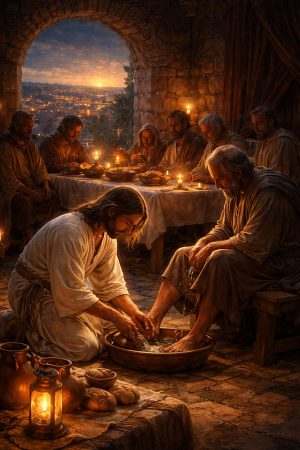
É uma noite de gestos simples e profundos, e o mais emblemático deles, o lavar dos pés, permanece como uma lição viva que atravessa o tempo. Em um mundo que valoriza a aparência, o poder e a exposição, aquele gesto inverte a lógica dominante, pois quem poderia se elevar, se inclina, e quem poderia se impor, serve, sem espetáculo, sem plateia, apenas com a força silenciosa da verdade.
E talvez seja justamente essa verdade que mais nos falta hoje, em tempos de ruído permanente, opiniões em excesso, certezas instantâneas e julgamentos apressados. Fala-se muito e escuta-se pouco, exibe-se muito e vive-se pouco, e nesse cenário a Quinta-Feira de Endoenças surge como um contraponto necessário, quase um chamado ao essencial, lembrando que há dimensões da vida que não se resolvem no espaço público, não se ajustam em discursos e não se curam com palavras bonitas.
Há questões que só encontram caminho no silêncio, na reflexão honesta e na decisão íntima de mudar o que precisa ser mudado, e é também por isso que nesta noite se fala de traição, não apenas aquela que marcou a história, mas uma outra, mais discreta e talvez mais presente, a traição de nós mesmos, quando sabemos o que é correto e escolhemos o mais fácil, quando adiamos decisões que já deveriam ter sido tomadas e quando nos afastamos daquilo que, no fundo, reconhecemos como verdadeiro, sendo que reconhecer isso não é fraqueza, mas começo.
A ceia permanece como símbolo de algo que também parece escasso em nossos dias, a comunhão real, não a convivência superficial, mas a capacidade de estar junto com verdade, respeito e escuta, pois em um mundo fragmentado esse talvez seja um dos maiores desafios contemporâneos, reconstruir vínculos que não sejam apenas formais, mas autênticos.
A Quinta-Feira de Endoenças não celebra, ela prepara, não resolve, mas orienta, não encerra, mas inicia um processo que se desdobra nos dias seguintes, funcionando como uma pausa antes da travessia e como um convite à lucidez interior.
E talvez, se soubermos escutá-la, possamos compreender que a vida não se transforma nos grandes acontecimentos visíveis, mas nas escolhas silenciosas que fazemos quando ninguém está olhando, pois são elas que, pouco a pouco, constroem quem nos tornamos, e é justamente nesta noite que se abre a oportunidade de recomeçar com mais verdade, menos ruído e maior consciência do caminho.
Maundy Thursday – The Silence That Prepares the Crossing
There are moments in the calendar that do not ask for explanation, but for reflection. Maundy Thursday is one of those rare occasions when time seems to slow down, as if life itself were inviting us to look inward before moving forward. In the Christian tradition, this is the night of the Last Supper, yet to reduce it to a historical episode is to miss its essence, for what is revealed there does not belong only to the past, it is a movement that repeats itself, quietly, in every life, a call to awareness.
The very name carries a message that has crossed centuries. “Maundy” comes from the Latin mandatum, meaning commandment, but its deeper tradition is also tied to indulgence, forgiveness, and reconciliation, and in plain terms it speaks to a decisive moment, the moment to set the soul in order before the trial, not only to seek forgiveness, but to offer it, not only to look at others, but to have the courage to look at oneself with honesty and without disguise.
It is a night of simple and profound gestures, and the most emblematic of them, the washing of the feet, remains a living lesson that transcends time. In a world that values appearance, power, and exposure, that gesture reverses the dominant logic, for the one who could rise chooses to kneel, and the one who could impose chooses to serve, without spectacle, without audience, sustained only by the quiet strength of truth.
And perhaps it is precisely this truth that is most lacking today, in times of constant noise, excess opinions, instant certainties, and hurried judgments. There is much speaking and little listening, much display and little living, and within this landscape Maundy Thursday emerges as a necessary counterpoint, almost a call back to what is essential, reminding us that there are dimensions of life that cannot be resolved in the public sphere, cannot be adjusted through speeches, and cannot be healed by well-crafted words.
There are matters that find their way only in silence, in honest reflection, and in the intimate decision to change what must be changed, and it is for this reason that this night also speaks of betrayal, not only the one that marked history, but another, more subtle and perhaps more present, the betrayal of ourselves, when we know what is right and choose what is easy, when we postpone decisions that should already have been made, and when we turn away from what, deep down, we recognize as true, and to acknowledge this is not weakness, but the beginning.
The meal remains as a symbol of something that also seems scarce in our time, true communion, not superficial coexistence, but the ability to be together with truth, respect, and genuine listening, for in a fragmented world this may well be one of the greatest contemporary challenges, to rebuild bonds that are not merely formal, but authentic.
Maundy Thursday does not celebrate, it prepares, it does not resolve, but it guides, it does not conclude, but begins a process that unfolds in the days that follow, serving as a pause before the crossing and as an invitation to inner clarity.
And perhaps, if we truly listen, we may come to understand that life is not transformed in the visible grand events, but in the silent choices we make when no one is watching, for it is these choices that, little by little, shape who we become, and it is precisely on this night that the opportunity opens to begin again with more truth, less noise, and a deeper awareness of the path.
José Roberto de Souza Dias

